Does an Empty House Sell Faster? The Truth About Vacant Home Sales
If you’re relocating for work, have recently inherited a property, or have already moved into your new home, you are likely staring at an empty house and wondering: “Will this sell faster without all my furniture in it?” It is one of the most common questions sellers face when timelines are tight.
The answer is rarely a simple yes or no. While some sellers assume an empty house serves as a “blank slate” that lets buyers imagine their own lives there, others find that vacant rooms feel cold, small, and uninviting. The reality of real estate data shows that both scenarios happen: we have seen vacant homes fly off the market in days, and we have watched others sit stale for months while similar furnished homes nearby get snapped up.
The difference usually isn’t the house itself—it is how that vacancy is managed. An empty house has undeniable logistic advantages, but it lacks the emotional “hook” of a staged home. Understanding the pros, cons, and specific strategies to bridge that gap is the key to a successful sale.
The Truth: Do Empty Houses Sell Faster?
Research on this topic is often conflicting because market conditions play a massive role. Some studies suggest vacant homes can sell up to 6% faster due to immediate availability, while others—specifically data regarding staged homes—suggest that furnished properties sell 73% faster than non-staged ones.
Why the discrepancy? It comes down to the trade-off between logistics and emotion.
From a logistical standpoint, empty houses are a dream. There are no scheduling conflicts, no sellers to displace, and agents can show the property at a moment’s notice. In a hot market where inventory is low, this speed can result in a faster sale simply because the barrier to entry is lower.
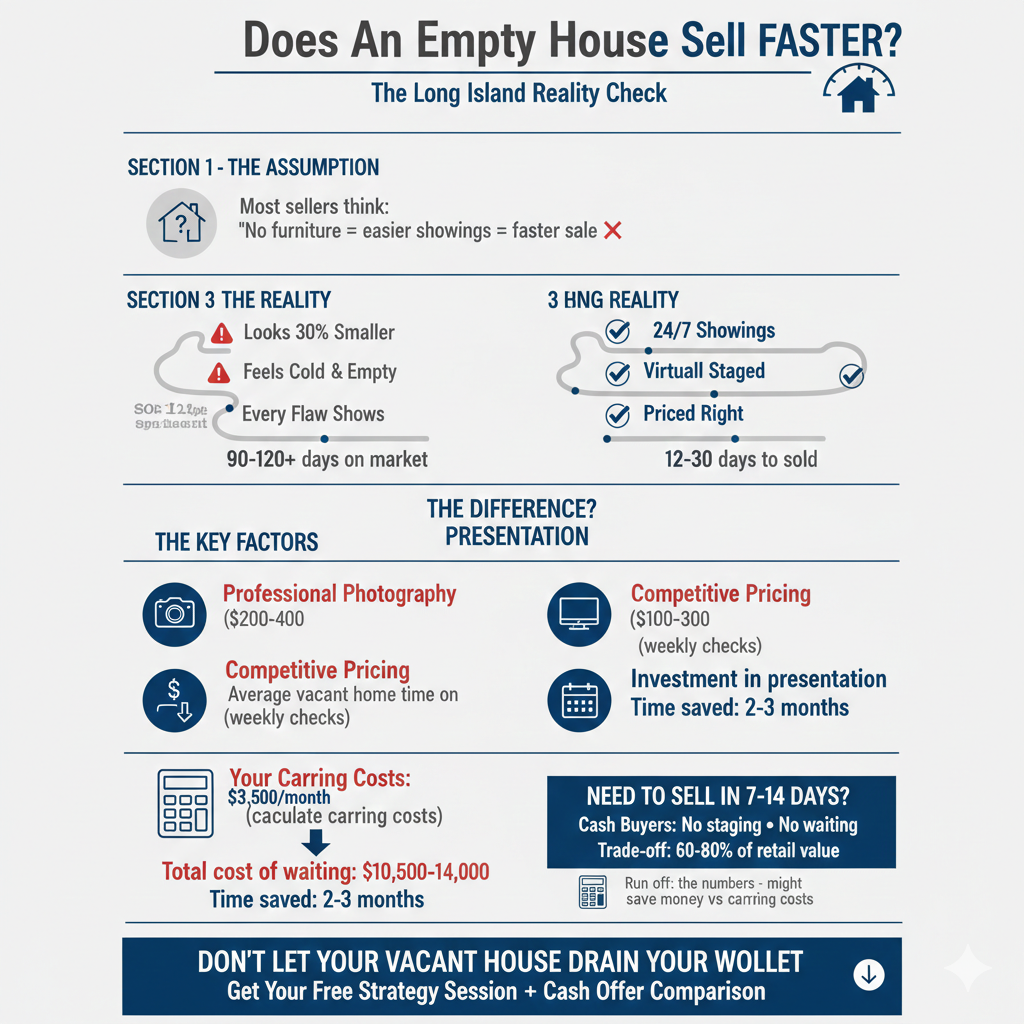
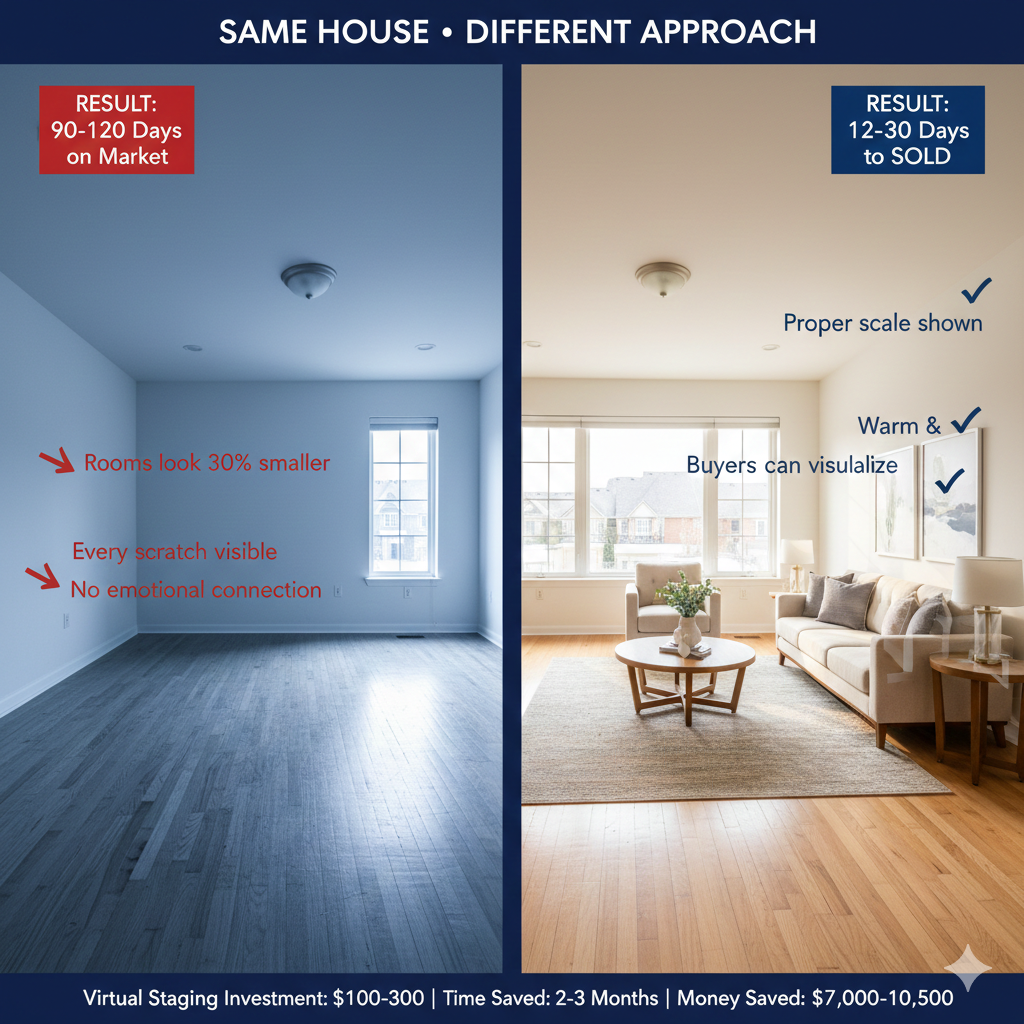
However, from an emotional standpoint, empty houses are at a disadvantage. Without furniture to provide scale, rooms often look significantly smaller. Without decor to provide warmth, the home can feel clinical. Flaws that would normally be hidden by a rug or a sofa become focal points.
In a seller’s market with low inventory, an empty house will likely sell fast simply because buyers are desperate for options. In a buyer’s market where inventory is high, an empty house often sits longer because it cannot compete with the emotionally appealing, staged homes listed at the same price point.
Advantages of Selling an Empty House
There are legitimate reasons to list a home vacant. If leveraged correctly, these benefits can streamline the sales process significantly.
- Showing Flexibility (24/7 Availability): This is the single biggest advantage. You can install a lockbox and allow agents to show the home whenever their clients are free—early mornings, late evenings, or weekends. You never miss a potential buyer because of a scheduling conflict.
- No Coordination Stress: You don’t have to worry about the “panic clean” before a showing. There is no need to coordinate with tenants, cage pets, or hide personal items. The property is always ready.
- A Neutral Canvas: For some buyers, particularly those with a strong creative vision, an empty house is easier to inspect. They can see the floor plan clearly without being distracted by the seller’s outdated furniture or clutter.
- Faster Closing Timeline: Because the home is already vacant, there is no need for a move-out contingency. If a buyer wants to close in 15 days, you can accommodate them. This is a major selling point for buyers on a deadline.
- Appeals to Investors: Investors and house flippers prefer empty houses. They want to see the “bones” of the property and, if they buy, they want to start renovations immediately. An empty house signals that the property is ready for work.
- Safety of Belongings: You don’t have to worry about theft or damage to your personal property during open houses. Your valuables are already moved out and secure in your new location.
Disadvantages of Selling Empty Houses
Despite the logistical perks, the psychological impact of an empty home can hurt your bottom line if not addressed.
- Rooms Look Smaller: It sounds counterintuitive, but empty rooms look tiny. Furniture provides a frame of reference. Without a bed in the bedroom to show scale, buyers often struggle to believe a King-size mattress will fit.
- Cold and Uninviting: People buy homes based on how they feel. An empty house creates an echo; footsteps sound hollow, and the atmosphere can feel sterile. It is difficult for buyers to form an emotional connection to a “box.”
- Highlights Every Flaw: Furniture and decor naturally draw the eye. When they are gone, the eye goes to the imperfections. Scuff marks on the baseboards, a crack in the plaster, or scratches on the hardwood floor become glaringly obvious.
- Security and Insurance Concerns: Vacant homes are targets for vandalism and squatters. Furthermore, many insurance policies have clauses that void coverage if a home is vacant for more than 30 or 60 days, requiring you to purchase expensive “vacant home” insurance.
- Seasonal Issues: In winter, a vacant house risks frozen pipes if the heat isn’t managed. In summer, stagnant air can lead to humidity buildup and musty smells.
- Perception of Desperation: Rightly or wrongly, buyers (and their agents) often assume that an empty house means the seller has already bought another home and is paying two mortgages. This can lead to lowball offers as they test your desperation level.
How to Make Empty Houses Sell Faster
If you must sell a vacant home, you are not doomed to a low price or a long wait. You simply need to employ specific strategies to counteract the “empty” feel.
Virtual Staging
This is the most cost-effective tool in your arsenal. For roughly $100-$300, you can have a graphic designer digitally insert furniture into your listing photos. This allows online buyers to see the potential of the space and visualize the layout. Since 95% of buyers start their search online, virtual staging stops the scroll. You can even choose styles—modern, farmhouse, or traditional—to match the home’s architecture.
Minimal Physical Staging
You don’t need to furnish the whole house. Consider “vignette staging” or staging key rooms only. Focus on the Living Room, Primary Bedroom, and Dining Area. Renting a few key pieces—a sofa, a rug, a coffee table, and a bed—gives the eye a place to rest and establishes the scale of the room. It makes the house feel like a home, not a warehouse.
Professional Photography
Do not rely on smartphone photos for a vacant home. Empty rooms are notoriously difficult to photograph; they can look distorted or dark. A professional photographer knows how to use wide-angle lenses and lighting to make empty spaces look bright, airy, and spacious. This is non-negotiable.
Maintain the Property
Just because you aren’t living there doesn’t mean you can ignore maintenance.
Climate Control: Keep the thermostat at a reasonable level to prevent dampness or freezing.
Landscaping: An overgrown lawn screams “abandoned.” Hire a service to cut the grass regularly.
Utilities: Keep electricity and water ON. Buyers will want to test faucets and light switches. A dark house is a scary house.
Price Competitively
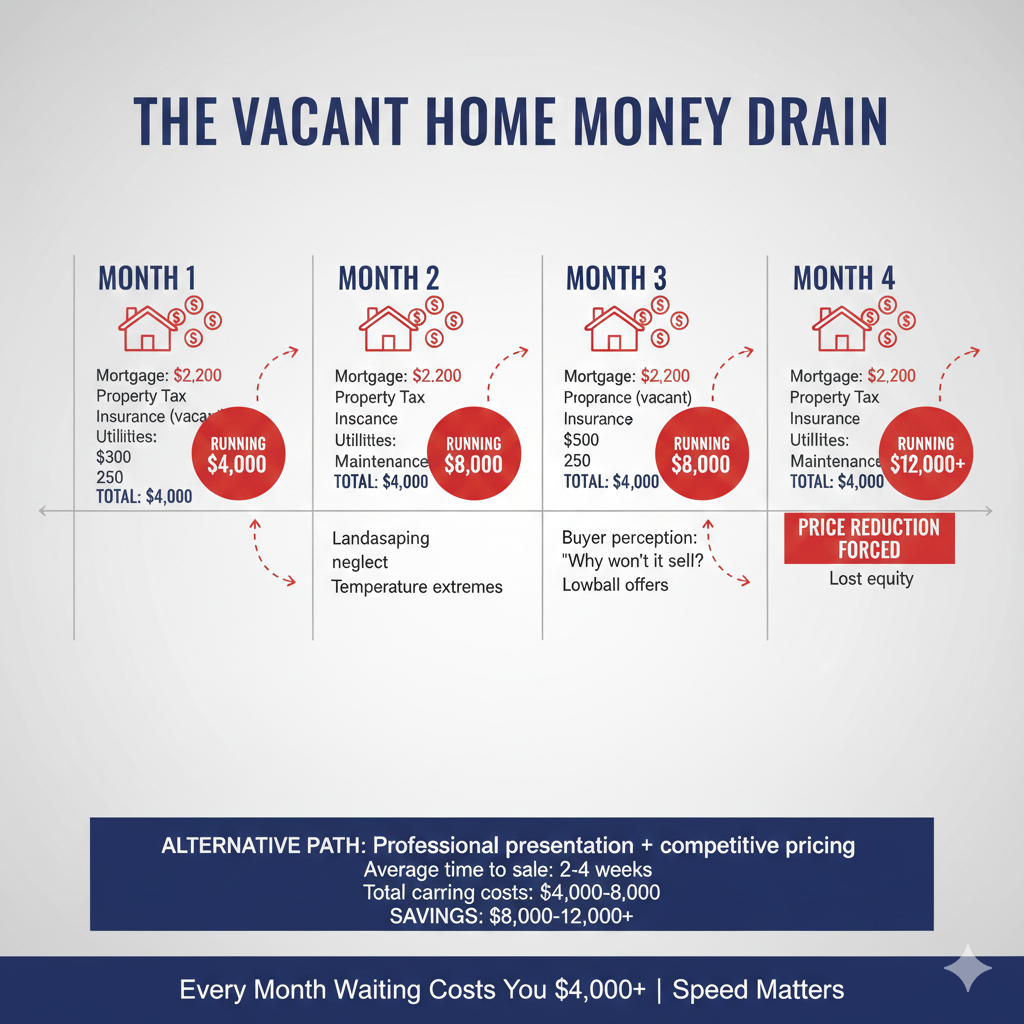
If you are selling an empty home without staging, you generally need to price it more aggressively than a staged competitor. Factor in your carrying costs (mortgage, taxes, insurance, utilities). It is often better to price the home slightly lower to trigger a bidding war immediately than to overprice it and let it sit for months while you pay bills on an empty property.
Vacant Home Marketing Strategies
To attract the right buyers, your marketing language needs to turn the vacancy into a feature, not a bug.
- Highlight “Move-In Ready”: Emphasize that the buyer can get keys immediately. Use phrases like “Immediate Occupancy” or “Ready for your quick move-in.”
- Emphasize Showing Flexibility: Explicitly state in the listing: “Easy to show,” “Go and show,” or “Available to view at your convenience.”
- Target Investors and Flippers: If the home needs work, market it as a “Blank Canvas” or “Renovator’s Dream.” Make sure the listing is syndicated to platforms where investors look.
- Virtual Tours: Matterport or 3D tours are essential for vacant homes, allowing out-of-town buyers to walk the floor plan virtually to understand the layout, which is often confusing in empty photos.
| When to Sell Empty | When to Invest in Staging |
|---|---|
|
|
Fast Sale Alternative: Cash Buyers
If the strategies above sound like too much work, or if you simply cannot afford the carrying costs of waiting for a traditional buyer, selling to a cash buyer is a viable alternative.
Empty homes are the perfect product for “We Buy Houses” companies and professional real estate investors. Unlike retail buyers, these purchasers do not care about staging, curb appeal, or emotional connection. They are looking at the numbers.
The Benefits of a Cash Sale for Vacant Homes:
- Speed: Closings can happen in as little as 7–14 days.
- As-Is Condition: No need to paint, repair, or clean.
- No Staging Costs: You save thousands on furniture rental and decor.
- Stop the Bleeding: You instantly stop paying mortgage, taxes, insurance, and utility bills on a house you aren’t using.
The trade-off, naturally, is price. Cash buyers typically offer below market value in exchange for the speed and convenience they provide. However, when you calculate the cost of holding a vacant property for 3–6 months plus the cost of staging and agent commissions, a cash offer often nets a similar amount with zero stress.
Common Mistakes with Vacant Homes
Avoid these pitfalls to ensure your listing doesn’t become stigmatized:
- Leaving it Completely Empty: Selling a house with bare windows, no toilet paper, and no doormat feels abandoned. Even a small “welcome kit” helps.
- Poor Photography: Using dark, amateur photos of empty corners is the fastest way to kill interest.
- Not Controlling Temperature: Buyers will cut a showing short if they are freezing or sweating. A comfortable house keeps buyers looking longer.
- Ignoring Maintenance: Piles of mail, dead bugs in the corners, or cobwebs suggest the house has been neglected structurally, not just visually.
- Overpricing: Vacant homes generally do not command the same premium as beautifully staged model homes. Pricing it too high “just to see” leads to price reductions later, which signals desperation.
Conclusion and Recommendations
Does an empty house sell faster? It can, provided you lean into the advantages of accessibility and mitigate the disadvantages of a cold presentation. If you are selling traditionally, we strongly recommend at least using virtual staging and ensuring the property is immaculately clean and well-lit.
However, if your primary goal is speed—if you need to offload the carrying costs immediately—a cash sale is the most efficient route. Before listing, calculate your monthly carrying costs and multiply them by the average days on market in your area. Compare that cost against the investment of staging. Be intentional with your strategy, and your vacant home will sell.
Are you ready to sell your vacant home?
Get a free staging consultation or a fair all-cash offer today.